
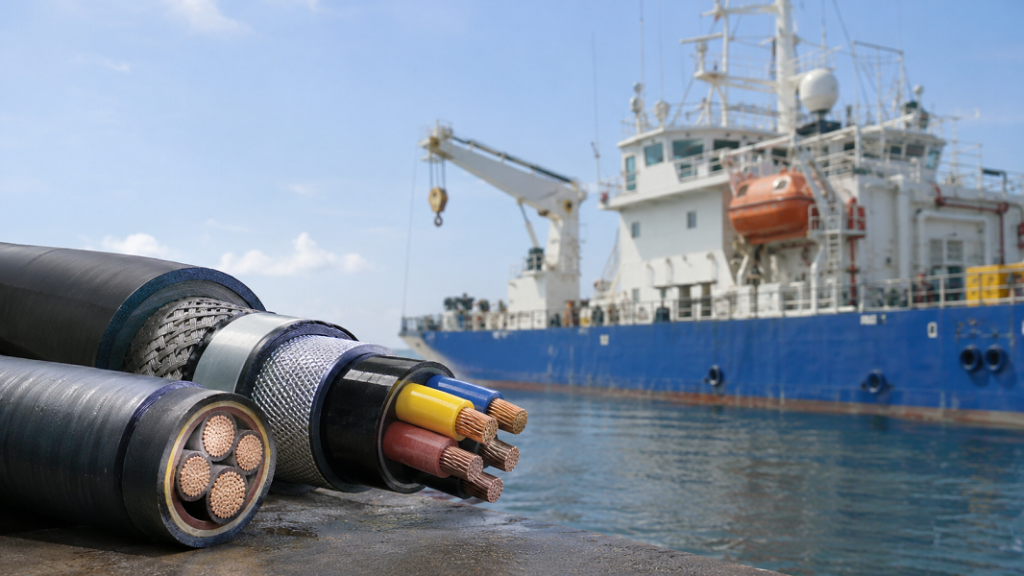
Electrical systems are one of the essential components in the operation of ships and the maritime industry. From navigation systems, lighting, and communication to machinery operation, all require a safe and reliable electrical network. To support these needs, specialized cables capable of operating in challenging marine environments are required, namely marine cables.
Unlike conventional electrical cables, marine cables are designed to withstand various extreme conditions, such as high humidity, seawater exposure, engine vibrations, temperature changes, and fire risks. Using unsuitable cables can increase the risk of electrical disruptions, equipment damage, and even threaten the safety of ship operations.
Therefore, understanding the different types of marine electrical cables is an important step before selecting the appropriate cable for maritime industry requirements.
This article will discuss the definition of marine cables, their various types and functions, key characteristics, and tips for choosing the right marine electrical cables.
What Is a Marine Electrical Cable (Marine Cable)?
A marine cable is a type of electrical cable specifically designed for use on ships, offshore facilities, and various electrical installations in maritime environments.
These cables function to distribute electrical energy, transmit control signals, and support communication and instrumentation systems used in ship operations.
In general, marine cables have constructions adapted to their operating conditions. Cable insulation and protective materials are selected to provide protection against environmental factors such as humidity, heat, vibration, and exposure to certain chemicals.
Marine cables are used across various types of vessels and maritime facilities, including cargo ships, passenger ships, tankers, patrol vessels, offshore support vessels, and offshore oil and gas platforms.
Although they all serve to conduct electricity, not all cables have identical characteristics. Each type of marine cable is designed for specific functions, voltage levels, and installation conditions.
Why Are Specialized Cables Needed in the Maritime Industry?
Marine environments have different characteristics compared to land-based environments. These conditions require ship electrical systems to have additional protection to maintain operational safety and stability.
One of the biggest challenges is high humidity. Exposure to water and salt-containing air can accelerate corrosion of metal components, especially when cable protection is damaged.
In addition, ships are constantly subjected to movement caused by ocean waves and engine vibrations. Over time, these conditions can place mechanical stress on cables, connections, and other installation components.
Fire risks are also a major concern. On ships, electrical faults can have serious consequences because operational spaces are relatively limited and evacuation procedures present unique challenges.
Therefore, marine cable selection must consider several important characteristics, including the following.
Resistance to humidity and maritime environmental conditions.
Resistance to vibration and mechanical stress according to installation requirements.
Electrical insulation capability appropriate for the operating voltage.
Protection characteristics against flame propagation.
Compliance with technical standards and ship safety requirements.
By using appropriate cables, the risk of electrical disruptions can be minimized while helping maintain equipment reliability during operation.
Types of Marine Electrical Cables and Their Functions
Marine electrical cables are available in various types based on their functions and construction characteristics. The following are several types of marine cables commonly used in the maritime industry.
Marine Power Cable
Marine power cables are used to distribute electrical energy from power sources to various equipment on ships.
These power sources may include generators, main distribution systems, or other power sources integrated into the ship’s electrical network.
Power cables are generally used to operate various equipment requiring an electrical power supply, such as electric motors, pumps, cooling systems, ventilation systems, and other operational support equipment.
In their applications, marine power cables must have current-carrying capacities appropriate for the equipment requirements.
Selecting the appropriate conductor size is also important to prevent excessive temperature increases and maintain voltage drops within permissible limits.
This type of cable is available in various voltage specifications and constructions, so its selection must be adjusted to the ship’s electrical distribution system.
Marine Control Cable
Marine control cables are used to transmit signals or support control circuits for various electrical and mechanical equipment on ships.
Control cables connect control panels to the equipment being operated, allowing systems to function according to the commands provided.
Examples of their applications include engine control systems, pump operations, automatic ventilation systems, and various ship automation devices.
Unlike power cables, which focus on electrical energy distribution, control cables are primarily used in control circuits.
Some applications require multicore cable constructions so that various control signals can be transmitted through a single cable route.
Under certain conditions, control cables also require additional protection against electromagnetic interference and mechanical stress.
Marine Instrumentation Cable
Instrumentation systems are used to monitor various important parameters during ship operations.
These parameters may include engine temperature, fluid pressure, tank levels, fuel flow, and the condition of certain equipment.
Marine instrumentation cables are used to connect sensors to monitoring systems.
Instrumentation cables are designed to support the transmission of measurement signals that require stability and accuracy.
Because some instrumentation signals have low amplitudes, electromagnetic interference from nearby electrical equipment can affect measurement quality.
Therefore, certain instrumentation cables are equipped with signal shielding or screening layers to help reduce electromagnetic interference.
Using appropriate instrumentation cables helps monitoring systems operate consistently, allowing operators to obtain more accurate information about equipment conditions.
Marine Communication Cable
Communication is an important part of supporting coordination and operational safety on ships.
Marine communication cables are used to connect various communication devices and data networks installed on ships.
Their applications may include internal telephone systems, computer networks, communication devices, and data exchange systems between electronic components.
Some communication cables use twisted-pair conductors to help reduce signal interference.
In addition, fiber optic communication cables are also used in certain data networks requiring high bandwidth.
Communication cable selection must consider the signal type, transmission speed, installation distance, and compatibility with the equipment being used.
With a stable communication network, information exchange between ship systems can take place more effectively.
Fire-Resistant Marine Cable
Fire safety is one of the main considerations in ship electrical system design.
In certain systems, cables must not only conduct electricity under normal conditions but also maintain circuit functionality for a specified period during a fire.
Fire-resistant marine cables are used for these requirements.
These cables feature special constructions designed to help maintain electrical continuity when exposed to fire under specified testing conditions.
Their use may be considered for essential safety systems, such as emergency lighting, fire alarms, and other safety equipment, according to the ship’s design requirements.
It is important to understand that fire-resistant characteristics differ from flame-retardant characteristics.
Flame-retardant cables are designed to limit flame propagation based on specific tests. Meanwhile, fire-resistant cables have additional requirements to maintain circuit functionality under defined fire conditions.
Therefore, fire resistance specifications must be carefully reviewed before selecting cables.
Armoured and Unarmoured Marine Cables
In addition to their functions, marine electrical cables can also be classified based on their mechanical protection construction.
Marine armoured cables are equipped with additional protective layers, such as braided or arranged metal wires, depending on the cable design.
These layers provide mechanical protection against the risk of impact, pressure, or certain installation conditions.
Armoured cables are generally considered for installation routes requiring additional protection due to environmental conditions or the risk of mechanical damage.
Meanwhile, marine unarmoured cables do not have an armour layer and can be used in installations with adequate mechanical protection.
Unarmoured cables may offer lighter construction and easier handling, depending on their type and specifications.
The selection between armoured and unarmoured cables must consider the installation location, support methods, operating conditions, and project technical requirements.
Marine Flexible Cable
Some equipment on ships requires electrical connections capable of accommodating movement or changes in position.
Under these conditions, marine flexible cables can be used when their product specifications match the application requirements.
Flexible cables generally use conductors consisting of numerous small wires to provide a certain degree of flexibility.
Their applications can be found in moving equipment, certain machinery, and systems requiring easier cable handling.
However, it is important to note that cables that are easy to bend are not necessarily designed to withstand continuous repetitive movement.
For dynamic applications, specifications such as minimum bending radius, resistance to repetitive movement, and installation conditions must be reviewed beforehand.
Understanding Marine Cable Construction and Materials
The reliability of marine electrical cables is determined not only by their types but also by the materials used in their construction.
In general, a marine cable may consist of conductors, insulation, filling layers, signal shielding, mechanical protection, and an outer sheath. Not all cables have every layer because their constructions are adapted to their functions and applications.
Conductors are the components responsible for carrying electrical current. Copper is widely used because it has good electrical conductivity. In some applications, tinned copper conductors are used to provide additional protection against corrosion.
The insulation layer separates conductors and prevents unwanted electrical contact. Materials such as XLPE (Cross-Linked Polyethylene) and EPR (Ethylene Propylene Rubber) are used in various cable constructions according to technical requirements.
Screening layers are used in certain cables to help reduce the effects of electromagnetic interference on signal transmission.
Meanwhile, the outer sheath provides protection against environmental factors and mechanical stress according to the characteristics of the materials used.
Some cables also use sheath materials with halogen-free and low-smoke emission characteristics to support specific safety requirements.
Material selection must always refer to technical specifications, installation conditions, and product testing standards.
Standards to Consider for Marine Electrical Cables
In the shipbuilding industry, technical standards play an important role in ensuring that cables have constructions and performance characteristics suitable for their intended applications.
One commonly referenced group of standards is IEC 60092, which covers electrical installations on ships.
Several relevant standards include the following.
IEC 60092-350 General construction requirements and testing methods for power, control, and instrumentation cables used on ships and offshore installations.
IEC 60092-353 Requirements for certain power cables used in fixed installations on ships and offshore units.
IEC 60092-376 Requirements for cables used in control and instrumentation circuits.
IEC 60332 Testing of flame propagation characteristics in cables under specified conditions.
IEC 60331 Testing of a cable’s ability to maintain circuit integrity when exposed to fire under defined testing conditions.
In addition to IEC standards, shipbuilding projects may require approval from certain ship classification societies, depending on the vessel type and project requirements.
It is important to ensure that the stated standards, certifications, and test results actually apply to the specific cable type being used.
How to Choose the Right Marine Cable
Selecting the appropriate type of marine cable cannot be based solely on price or conductor size.
Each installation has different requirements, so cable selection should be based on technical specifications and the characteristics of the operating environment.
Match the Voltage and Current Requirements
The first step is to determine the voltage and current capacity requirements of the electrical system.
Cables must have appropriate rated voltages and sufficient current-carrying capacities.
Conductor sizes must also be calculated by considering cable route length, installation methods, ambient temperature, cable grouping, voltage drop, and electrical fault conditions.
Proper selection helps reduce the risk of overheating and maintain energy distribution efficiency.
Consider the Installation Environment
The installation location is an important factor in determining cable construction.
Cables installed in engine rooms may face different conditions compared to cables located in open areas or near vibrating equipment.
Some installations may require protection against oil, ultraviolet radiation, humidity, or mechanical stress.
Therefore, the characteristics of insulation and sheath materials must be reviewed based on actual operating conditions.
Consider Fire Protection
In areas or systems with high safety requirements, fire protection characteristics must be considered.
Cable types may be selected based on flame-retardant, fire-resistant, low-smoke emission, or halogen-free requirements according to project specifications.
Not all marine cables have the same level of fire protection. Therefore, performance claims must be supported by relevant specifications and testing.
Check Standards and Technical Documents
Before purchasing, ensure that the product has clear technical information.
Documents that should be reviewed may include conductor sizes, rated voltages, insulation materials, protective construction, operating temperature ranges, and testing standards.
If a project requires classification society approval, the approval documents for the relevant cable type must also be verified.
Consulting a cable manufacturer can help determine the most suitable product for the installation requirements.
Tips for Marine Cable Installation and Maintenance
Good cable quality must be supported by proper installation and maintenance methods.
Improper installation can reduce cable reliability, even when the products used meet technical specifications.
During installation, cable routes should be planned to avoid excessive stress, friction against sharp surfaces, or heat exposure exceeding the material’s limits.
The minimum bending radius must also be considered to prevent damage to conductors and insulation layers.
In addition, cable supports, connectors, and termination systems must be selected according to cable characteristics and environmental conditions.
After installation is completed, inspections can be conducted through continuity testing, insulation resistance testing, and connection verification according to applicable procedures and technical requirements.
During routine maintenance, several conditions should be monitored, including discoloration caused by heat, sheath damage, corrosion at terminations, and loose connections.
Regular inspections help detect potential damage before it develops into more serious disruptions.
Common Mistakes in Selecting Marine Electrical Cables
One common mistake is assuming that all electrical cables can be used in ship environments as long as their sizes and voltage ratings are suitable.
In fact, operating conditions in maritime environments require additional considerations that may not be addressed by cables designed for general installations.
Another mistake is selecting cables based solely on initial price without considering maintenance costs and potential operational disruptions.
Cables with unsuitable specifications are at risk of experiencing faster performance degradation and may result in additional repair costs.
In addition, using cables without considering mechanical protection requirements or fire safety characteristics can also create risks.
To avoid these situations, marine cable selection should be based on system requirements, technical documentation, and applicable safety regulations.
PCM Cable as a Marine Cable Solution for the Maritime Industry
Selecting the right marine electrical cables is an important part of maintaining the safety, efficiency, and reliability of ship operations.
In addition to understanding cable types and characteristics, working with an experienced manufacturer can also help ensure that the selected solutions meet project requirements.
PT PCM Kabel Indonesia is a specialized cable manufacturer with experience dating back to 1994 in supporting the needs of various industrial sectors.
By combining decades of technical experience with modern manufacturing technology, PCM Cable continues to develop cable solutions that prioritize quality, reliability, and suitability for customer requirements.
One of its available product lines is Marine & Offshore Cables, which includes cable options for power distribution, control, instrumentation, and various electrical requirements for ships and offshore installations.
PCM Cable also provides a selection of cable constructions that can be adapted to application specifications, including cables with mechanical protection, screening, and certain fire resistance characteristics.
For shipbuilding companies, electrical contractors, and offshore industry professionals planning projects, selecting cables with appropriate specifications is an important investment in supporting long-term reliability.
If you need further information about marine cables, ship cables, or specialized cable solutions for industrial requirements, the PCM Cable team is ready to help discuss your project specifications and needs.
Visit www.pcmcable.com or contact the PCM Cable team via WhatsApp to obtain product information, cable consultation, and quotations according to your project requirements.
Read another article https://pcmcable.com/hal-yang-perlu-diperhatikan-saat-memilih-kabel-marine/
